These Presents
06/07 – 21/07
Objects migrate, as people do. Their lives are attached to the affects with which we cover them, as an embrace that hides a memory, a desire, or a promise. The objects we carry are the remnants of the places we have visited, the people we have encountered, and also the sum of all the things we have also left behind or lost. Objects are not just merchandise or a collection. They participate in a contemporary world where the machinery of capitalism seems to have agglutinated everything and yet objects still carry our love.
In the midst of museums, collections, and objects, Chilean artist Felipe Pineda (b. 1995) configures a world of meaning with which we all can relate: souvenirs and all their itineraries. Souvenirs are not hollow representations of museum shops, but stories that have yet to be told when they arrive at their destination as gifts. The artist, while visiting tens of shops, discovered multiple objects which he safeguarded as uninteresting monuments that speak to his family and loved ones, to his life and memories. A pen for his father, a wristband for his nephew, a magnet for his grandparents, and some earrings for his mother. Objects coated with absurd cultural references, both innocent and complex at the same time.
These artefacts, which have now travelled, are presented as sculptures, creating a new dislocation for them. From being cultural references, to merchandise, they are now newly brought back to display like in museums, as the “original objects” also accompany the daily routines of the artist’s family as utilitarian materials. In this subtle and poetic encounter of oxymorons, the artist moves beyond the fever of collections and decolonisation projects, institutional critique, or even representational matters. These sculptures are carriers of meaning, now living in other cities and on other continents. Stories of affection, memory, and even longing, that nevertheless do not succumb to propaganda or the deactivation of a revaluation of the politics around their existence.
In here, we are faced with a question that Pineda uncovers: how have we structured the world around things, their movements, and their narratives; then in ancient and living cultures, and today with industrialised, mass-produced objects.
Santiago Valencia Parra


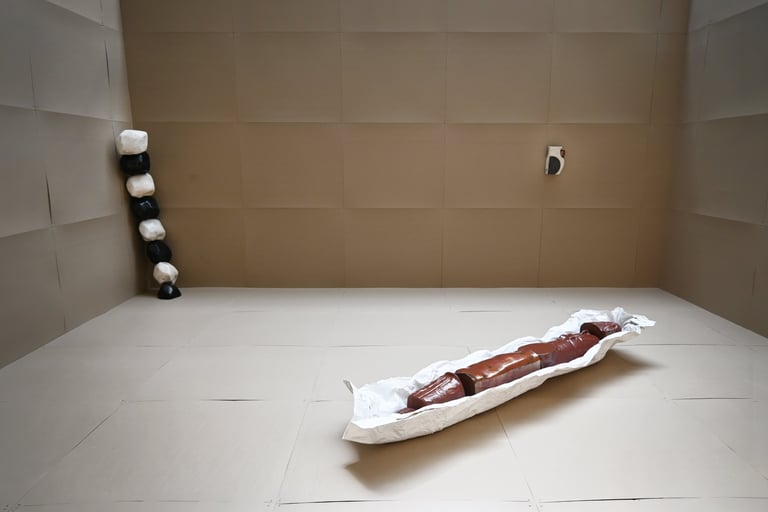
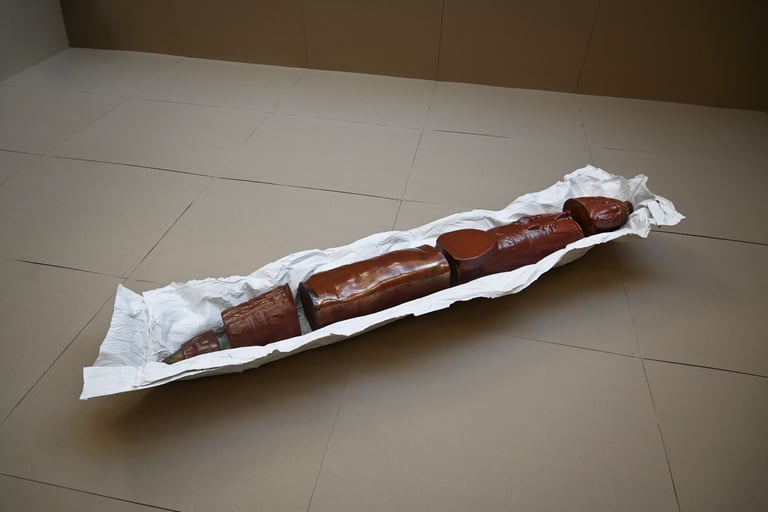
Egyptian Character Pen, 2026, 250 x 40 cm x 35 cm, Ceramics and jesmonite
Egyptian Character Pen, 2026, 250 x 40 cm x 35 cm, Ceramics and jesmonite
Earrings and fans come from far away, 2026, 35 x 40 x 30 cm, Ceramics.
Earrings and fans come from far away, 2026, 35 x 40 x 30 cm, Ceramics.
Classic magnet to add to the collection, 2026, 15 x 30 x 35 cm, Ceramics, jesmonite, resin, iron powder.
Classic magnet to add to the collection, 2026, 15 x 30 x 35 cm, Ceramics, jesmonite, resin, iron powder.
Not real sugar, not real skulls, 2026, 180 x 35 x 50 cm, Jesmonite and resin.
Not real sugar, not real skulls, 2026, 180 x 35 x 50 cm, Jesmonite and resin.
Letters
Not real sugar, nor real skulls
I've always enjoyed listening in on other people's conversations, and I think you do too. Once, in the Mexico gallery at the British Museum, I overheard two people with Mexican accents saying that the mosaic skull of Tezcatlipoca had been incorrectly labelled.
After leaving the gallery, I went to the museum shop and bought you this skull bracelet. Unlike the "mislabelled" object, this bracelet is inspired by the calaveritas de azúcar—the sugar skulls made for Mexico's Day of the Dead. Those, in turn, trace their origins to what the Mexica called the Tzompantli, a rack where human skulls were displayed.
Even so, the skulls on this bracelet aren't made of sugar either— they're probably plastic. That's why my biggest fear is that you'll try to eat one, just like your dad did with a marble when he was your age.
Soon, when you come to visit me, we can go back to the museum together—to look at skulls, or simply to listen to other people's conversations.


Egyptian Character Pen
Stone carvers are people who write down what others say. In their time, they carved the words spoken in important conversations into stone. What you do now isn't so different—except they worked with stone, and you work with pencil and paper.
I look at this pencil, which I once thought was a sarcophagus, only to discover that it is nothing more than what the museum label calls an "Egyptian character"—just an ordinary person. A stranger whose story I'll never know, though perhaps you would. Trapped inside the body of a pencil, carver or not, this figure does something much like you do: it writes at the impulse of a hand that is not its own, quietly offering its graphite so that others may have a voice.
Now this figure will become part of your pencil collection, alongside all the pencils worn down from so much writing.


Earrings and fans come from far away
Your loved ones always said that you were the one who gave the best gifts—that your way of giving was essentially about finding something truly special for the person receiving it.
When you came here last year, following the lesson you taught me about travelling in Europe, we went to several museums, including the Victoria & Albert Museum. After the person we were with got lost, we wandered through the galleries together. Thinking about it now, that must have been the only time the two of us walked through a museum on our own.
A few months later, I went back to the museum by myself and bought you these fan-shaped earrings, which, according to the museum, are inspired by Japan. They're made of imitation gold and come in six different colours: blue, pink, yellow, green, red, and purple. Reading about the history of folding fans, I discovered that their origins are uncertain—some trace them back to Egypt, others to China. It doesn't really matter. What matters is that you feel these earrings were chosen especially for you.


Classic magnet to add to the collection
Your house was always the one place where I could drink soda, since I wasn't allowed to have it at home. I remember sneaking into the kitchen during the afternoon siesta, looking for a soft drink, and opening that door covered in magnets—the biggest magnet collection I'd ever seen.
When people don't know what to bring you back from a trip, they give you a magnet. In your case, though, it's the opposite. It's as if magnets were made for you. A collection that large can only mean one of two things: either you've travelled a lot, or people think of you whenever they travel. I like the second explanation better.
I bought you this vase-shaped magnet at a museum in Europe. Maybe, at one time, a vessel like this was used to carry a different kind of drink, something not so unlike soda. Maybe another child once sneaked up to a vessel like this to drink something they weren't supposed to.

